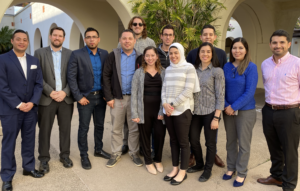

The webinar will explore methods of integrating global virtual teamwork into the business school curriculum and offer tips for planning for - and achieving - outcomes as good, if not better, than those we achieve in face to face teams. Global consulting projects , chiefly the Global Business Project course offered collaboratively by 15 US and international business schools, will serve as the base for this webinar, but the "lessons learned" and "how to" will be applicable to a wide array of global business courses employing virtual teamwork.
This webinar is intended for US and international faculty who either engage themselves in geographically dispersed teams and/or run courses in which students work in virtual teams.
4:15-5:15 pm EST
The Centers for International Business Education and Research (CIBERs) were created by Congress under the Omnibus Trade and Competitiveness Act of 1988 to increase and promote the nation's capacity for international understanding and competitiveness. Administered by the U.S. Department of Education under Title VI, Part B of the Higher Education Act of 1965, the CIBER network links the manpower and technological needs of the United States business community with the international education, language training, and research capacities of universities across the country. The 33 CIBERs serve as regional and national resources to business people, students, and teachers at all levels. This grant program adheres to the Education Department General Administrative Regulations (EDGAR) Title 34, Code of Federal Regulations (CFR), Parts 74-86 and 97-99.
[More]Dr. Mary Risner, a UF-CIBER affiliate and director of outreach for UF's Center for Latin American Studies, conducted a business-language track at the 2011 Florida Foreign Language Association Conference. The session, on Brazil and Portuguese, focused on how learning this language will give students a competitive advantage in their future careers and complement their knowledge of Spanish-speaking Latin America. The conference also included language-specific sessions in ASL, Chinese, French, German, Japanese, Latin, and Spanish. Participants gave positive feedback on the seminar. Said one participant, “Keynotes really did a phenomenal job showing us the real world connections to languages and the business applications.”